
Articles from the Archives

Over the years Ive contributed to many club and society newsletters and magazines and had the privilege of being an editor on some of these small but no less important publications. From tiny acorns huge Oak trees grow.
If you will indulge me a little - it seems a shame not to share some of these articles and field trip reports from ten, to twenty odd years ago (or more!) memories made mainly with my friends and members of the Milton Keynes Geological Society.
Fossicking in Faringdon
A field trip report about Rogers Concrete, Faringdon, Oxon August 18th 2013
By Colleen Thomson

I had the good fortune of having annual leave at the same time as one of our organised MKGS field trips. As many of you know, I am primarily a mineral collector. However, as mineral collecting trips are rather sparse and my lack of knowledge about fossils something of a black hole, I decided it would be a great opportunity to become better acquainted with the famous sponge beds of Faringdon.
My usual collecting gear of lump hammer, pick, chisels, goggles, gloves etc were not needed on this collecting trip. In fact, on enquiring what collecting equipment I should bring, I was told – tweezers.
Seriously?
….oh and a small screw top container.
…and maybe a kneeling pad.
Ok then. But aren’t we collecting Sponges? Yes, but smaller stuff too, and these sponges are smaller and more eroded like they’ve been tumbled on the foreshore. Apparently, the larger, better known sponges are from a quarry on the other side of the road and were probably in deeper water during the cretaceous.
Here’s a brief explanation - *The Sponge Gravel is part of the Lower Greensands, and it consists of fossils and fossil fragments set in a sandy matrix. Most of the fossils are sponges, but other common fossils include shellfish, sea urchins and their spines, and belemnites.
The Sponge Gravel formed around 115 million years ago during the Cretaceous, when the area was submerged under the sea. Sponges lived on the sea floor, but when they died they became detached from the seafloor, and underwater currents swept them into deep hollows where they accumulated, and after millions of years became fossilized to form the sponge gravel.
Formation of the Sponge Gravel.

*Info & Graphics from the Oxfordshire Geology Trust
*NJ Snelling wrote in 2002 ‘…Specimens have been collected from Faringdon since
at least the seventeenth century.
Faringdon's fossils occur in an often friable rock which can sometimes be even crumbled in the hand with the fossils literally falling out intact.
The deposit is particularly well known for the occurrence of fossil sponges which resemble cigarette ends, egg cups and tea cups, the larger specimens sometimes look as if they were badly fired and had started to sag. The sponge zooid is a unicellular creature, about 250 of which would form a queue about an inch long. They live in a colony and secret a porous nest-like structure through which water can circulate essential nutrients.
The calcareous sponges in which the nest is calcareous (made of lime) is the type found at Faringdon. The porous interior has long since been filled with secondary minerals (calcite) so the fossils are generally solid and robust. Other common fossils are beautifully preserved bivalve shellfish, sea urchins (usually fragmented) and their spines, and also fossils derived from the underlying Jurassic particularly the bullet-like belemnites, fish teeth and occasionally a piece of dinosaur ( I have a plesiosaur vertebra which makes a convenient paper weight on my desk).’
Incidentally, the hollows in the seabed into which the sponges were deposited were about 10 meters deep, with the deposit as a whole, being about 50 meters deep.
Meanwhile, back in Faringdon….
We signed in the visitors’ book at the Rogers’ Concrete office. Marion and Geoff (MK GeoSoc members) are well known to the owners and have been frequenting the pits locally for many years. We were also met there by David Graby another MKGS member and fossil collector. We drove through the yard and parked the van at the top of the gradient leading into the old workings. Most of the pit is now

pretty overgrown, with a lot of Buddleia, nettles, brambles and some unknown but rather lovely wildflowers everywhere, that the butterflies seemed to like. As usual, I spent as much time enjoying the flora and fauna as I did actually looking for fossils!


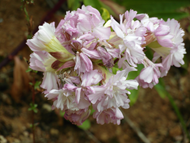
The weather was reasonable for the majority of our visit, staying dry until lunchtime when it tipped down and we stoically donned our wet weather gear and carried on. Or at least I sat on a rock chatting to Marion and drinking coffee out of a flask ( I don’t go far without it)!
Previously, I had been watching the other’s fossicking technique – it takes a while to ‘get your eye in’, particularly when your eyesight is a bit dodgy…. But collecting fish and crocodile teeth that are only about 5 – 10mm in size, amongst a gritty sandy gravel is a challenge, as demonstrated by Marion…..

But this method of collecting obviously works as she found several teeth and good echinoid spines this way.

Echinoid spines seem relatively common, if a bit battered, but the sea urchins themselves are quite rare, and when found, are very small (about a centimetre across) which could explain why they are so often overlooked. I was delighted therefore to come across one that had washed out of the bank. I had also managed to find a couple of teeth, so I was rather pleased with myself (even if I had collected a few random bits of gravel…).
Both David and Geoff had wandered off on their own collecting quests.

Geoff had climbed up the steep bank towards the top of a cliff where he continued working an area he had been sieving sponges out of the gravel over many previous visits. A lot of the sponges here were a lot more damaged and appeared to have been water –worn or smoothed perhaps by wave action on a foreshore, or at least a shallower area than where the larger, complete sponges had previously been collected from a different quarry in the area some years ago.
Geoff has a sizeable sponge collection from Faringdon (dare I say, probably the most comprehensive collection in existence) and was searching for species that had so far eluded him. The spoil heap alone was several feet high and looked like this …

There were a few sponges here that came home with me
Despite the heavy downpour, it was actually a really great day. The cliffs were fascinating and were overflowing with crushed shells, bits of sponge and bryozoan pieces. As usual the company was wonderful and I’m thankful to Geoff and Marion for allowing me to share the paleo wagon and giving me the opportunity and experience of collecting here.

And yes….those tweezers really worked!

Above : My haul of mini fossils including fish teeth, Echinoid; echinoid spines, Bivalves

Some of the sponges I collected
*further reading about Faringdon geology here -http://www.faringdon.org/uploads/1/4/7/6/14765418/faringdons_fossil___information_njsnelling.pdf
"Faringdon Sponge Gravel Formation"
http://data.bgs.ac.uk/doc/Lexicon/NamedRockUnit/FSG.html for more technical geology information
PLEASE NOTE- IMPORTANT!!
ALL OF THE LOCATIONS FEATURED ARE PRIVATELY OWNED AND PERMISSIONS MUST BE SOUGHT BEFOREHAND. MANY ARE NOW NO LONGER ACCESSABLE.


Comments